
Your energy bill shows VAT at 20% and a separate Climate Change Levy charge. The meter readings look reasonable, so you pay it. Yet the tax treatment deserves a check too, particularly if you run a small shop, share a supply with a flat, or provide residential care.
VAT on business energy is normally charged at the standard rate. But low consumption and certain uses can qualify for reduced VAT and exclusion from CCL, with a temporary zero rate for qualifying electricity in Great Britain during the period below. The important question is why your supply qualifies, not simply whether your business would benefit.
This guide uses HMRC guidance checked on 30 September 2026. It is general information, not individual tax advice; ask your accountant to review uncertain eligibility or mixed-use calculations.
October 2026 update: qualifying electricity in Great Britain
HMRC's VAT Notice 701/19 specifies temporary 0% VAT from 1 October 2026 to 31 March 2027 for qualifying electricity supplies in England, Scotland and Wales. Qualifying electricity in Northern Ireland remains at 5%. This does not make ordinary standard-rated business electricity eligible, and it is not a temporary zero rate for gas.
The qualifying-use tests are unchanged. References below to the usual 5% reduced rate must be read alongside this temporary electricity rule. Ask the supplier to check invoices spanning the change and any mixed-use allocation; do not apply 0% to an entire business bill without confirming eligibility.
For short answers and related topics, visit our business energy VAT and CCL FAQs.
Start with consumption, not your business type
You do not have to be a charity to qualify for 5% VAT on business electricity. Small supplies can receive the reduced rate regardless of what the premises are used for. HMRC calls these the de minimis limits.
| Fuel | Average daily limit | Monthly equivalent stated by HMRC |
|---|---|---|
| Electricity | Not more than 33 kWh | 1,000 kWh |
| Piped gas | Not more than 145 kWh | 4,397 kWh |
These are consumption limits, not spending limits. A higher unit price does not by itself change eligibility. Check the billing period and average usage rather than comparing an entire quarterly bill with a monthly figure.
Gas and electricity are assessed separately. A site can qualify for reduced VAT on electricity while paying standard VAT and CCL on gas.
Be careful with the phrase “per meter”. HMRC describes supplies to one customer at any one of that customer's premises. If you have several meters at the same premises, ask the supplier how the supplies are assessed; do not assume each meter provides another allowance. Check separate premises individually, rather than adding your entire company's usage together. See VAT Notice 701/19, sections 4.2 and 5.2.
Qualifying small quantities should receive reduced VAT automatically, without a qualifying-use certificate. Even so, check the bill: an estimated reading, an unusual billing period or an account change is worth querying if the treatment looks wrong.
When the building's use makes a difference
Above those limits, qualifying residential use can still matter. Examples include care homes, hospices and qualifying student accommodation. A flat above a shop also deserves attention when both share a supply; a commercial account name does not settle the tax treatment.
Charities can qualify for energy used in non-business activities. Trading activity is not automatically eligible just because its profits support a good cause. A community interest company is not automatically entitled to charity relief: the Charity Commission distinguishes CICs from charities.
For mixed qualifying and non-qualifying use, the 60% rule matters. If qualifying use reaches 60%, the whole supply can receive reduced VAT. Below that level, the qualifying part receives 5% and the remainder 20%. Charities can find the corresponding rules in HMRC's charity VAT guidance.
The split needs evidence of energy use, not an optimistic guess based only on floor area. Submeter readings, equipment use and occupancy records can help you explain the calculation. Ask your accountant to check the method before signing a declaration, especially where a kitchen or heating system serves both areas.
What the CCL line should show
Climate Change Levy is a tax on business energy consumption, separate from VAT. VAT is then calculated on the taxable bill including CCL. It is not another supplier unit rate you can negotiate away.
For electricity and piped gas, qualifying domestic, charitable non-business and small-quantity supplies are excluded from CCL. The HMRC fuel and power manual explains the connection with reduced VAT and mixed-use certificates.
If the whole gas or electricity supply correctly qualifies for 5% VAT but CCL is charged on that same supply, challenge it. However, seeing 5% VAT and CCL somewhere on the same invoice is not proof of an error: a mixed-use bill can include a qualifying portion and a taxable business portion. Ask which consumption the levy covers.
Current CCL rates
| Fuel | From 1 April 2026 | From 1 April 2027 |
|---|---|---|
| Electricity | 0.801p/kWh | 0.827p/kWh |
| Piped gas | 0.801p/kWh | 0.827p/kWh |
| LPG | 2.175p/kg | 2.175p/kg |
These are main rates before VAT, not discounted rates. The next year's published figures are included to help you recognise a rate change, not to apply them early. Source: HMRC's CCL rates.
A worked example: what changes on the bill
Suppose a small shop's electricity supply qualifies under the low-use rules. This example uses the usual 5% treatment before the temporary Great Britain electricity change, for a qualifying supply billed wholly in September 2026. For this illustration, consumption is 900 kWh in a 30-day billing period and the energy plus standing charges total £250 before tax. Those are example figures, not a tariff quote.
Average use is 900 ÷ 30 = 30 kWh a day, below the electricity limit. If the supplier mistakenly applied full CCL and standard VAT, the arithmetic would be:
CCL: 900 × £0.00801 = £7.209, approximately £7.21.
Incorrect total: (£250 + £7.209) × 1.20 = £308.65, rounded.
Correct qualifying total: £250 × 1.05 = £262.50, with no CCL.
The difference is £46.15 for this illustrative bill. Actual invoice rounding can vary slightly.
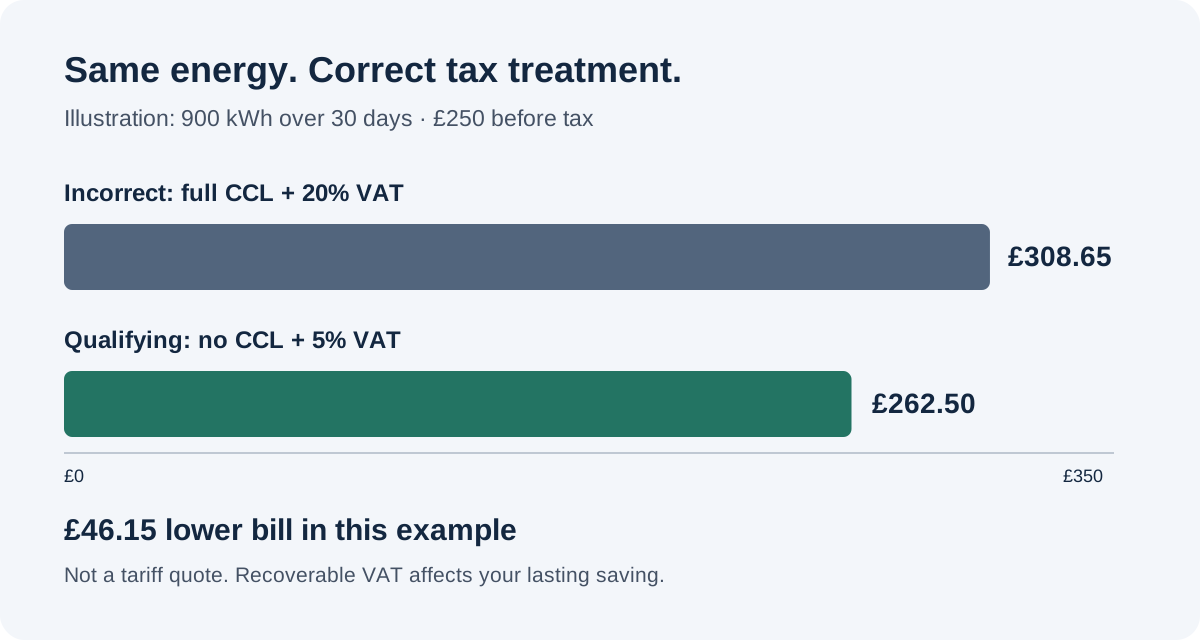
The chart illustrates that September 2026, 5%-VAT example only. At the temporary qualifying 0% electricity rate, the same £250 pre-tax charge would total £250, with no CCL, if all eligibility and timing conditions are met.
That is not necessarily £46.15 of permanent savings for every business. If you are VAT registered and make taxable supplies, you can normally reclaim eligible input VAT under the usual rules. The lasting benefit then mainly concerns CCL, alongside cash flow. See HMRC's input VAT guidance.
The VAT reduction matters more where VAT cannot be recovered, including many non-registered or partially exempt businesses, charities and residential landlords. Your VAT scheme and activities affect the answer.
Ask for a correction with evidence
Do not assume the supplier knows how your premises are used. Standard treatment may remain in place until you provide the information needed for a qualifying-use claim. Start by collecting:
- Bills showing the supply address, account and meter references, billing dates, usage, VAT and CCL.
- Evidence of qualifying use and its start date, such as occupancy records or charitable activities.
- Your calculation of any mixed-use percentage and copies of earlier declarations.
The Aarubi energy bill checker can help you start reviewing the bill. Eligibility still needs supporting evidence; a bill check cannot replace a declaration or an accountant's advice.
Ask the supplier for its VAT declaration process where required, written confirmation of the percentage accepted and the effective date. Submit details to each relevant supplier. When switching, give the new supplier the necessary declaration; do not assume the previous arrangement transfers.
Incorrect claims can lead to tax being recovered. Responsibility depends on the error and the tax involved, so do not treat acceptance by a supplier as a guarantee that the claim is correct. Keep records and report changes in use.
Refunds and specialist CCL relief
Ask about earlier bills as well as the next one. Evidence-backed corrections can reach back four years, but this is not an automatic entitlement to four years of refunds. For overcharged VAT, approach the supplier for corrected paperwork; HMRC explains the correction and time-limit rules.
Energy-intensive businesses may qualify for CCL reductions through a Climate Change Agreement. This is a separate route, not a general small-business discount. The government's CCL overview explains eligibility.
For specialist certified relief, PP10 supports the analysis sent to HMRC and PP11 tells the supplier what relief to apply. Review entitlement at least annually; an unchanged, correct certificate does not require automatic annual resubmission. There is no universal mid-April filing deadline. Where an existing certified percentage was too low, CCL200X may be the appropriate HMRC tax-credit route rather than a retrospective replacement certificate. Follow Excise Notice CCL1/3 with your adviser.
FAQs
Does a green tariff remove CCL?
No. The renewable-electricity exemption ended for electricity generated from 1 August 2015, so a green tariff alone does not remove the charge. See HMRC's exemption notice.
Can my café get 5% VAT on gas?
Potentially, if its supply meets the small-quantity test or another qualifying-use rule. Being a café does not itself qualify you, and electricity eligibility does not determine gas eligibility.
Do I need PP10 and PP11 for low-use relief?
Not for the ordinary small-quantity exclusion. Ask the supplier to check the consumption-based treatment rather than assuming specialist CCL forms are necessary.
Can I claim a business energy VAT reduction after switching?
Ask the previous supplier to review its own bills and give the new supplier any declarations it needs. Keep evidence covering the period claimed; a current qualifying position does not prove the same position existed earlier.
Want another pair of eyes on your bill?
Last updated: 30 September 2026. Check the temporary qualifying-electricity VAT period from 1 October 2026 to 31 March 2027, review CCL rates each April, and revisit eligibility whenever your premises or activities change.
If you are unsure which charge to question, contact Aarubi for a bill check. We can help identify the issue to raise with your supplier, with your accountant confirming any tax treatment that needs professional judgement.