
You signed a fixed energy contract to avoid surprises. Now the bill is higher. Has your supplier changed the deal, or did “fixed” mean something different from what you expected?
Start by separating the price you pay from the amount you use. A fixed rate does not fix your total bill. More consumption, a longer billing period or a correction to estimated readings can increase the amount due without changing any agreed rate.
There is another possibility: only part of your price was fixed. Some business contracts include variable third-party costs or later reconciliations. Others fix the included network and policy costs for the term. The contract wording—not just the product name—determines which applies. Ofgem explains pass-through pricing.
This business energy bill breakdown for 2026 explains what to look for, using sources checked on 18 September 2026. Network arrangements described here apply to Great Britain; Northern Ireland has a different electricity market.
Unit rate and standing charge: where the costs appear
Your unit rate is the price per kilowatt-hour (kWh). Your business electricity standing charge is normally a daily amount, payable even when you use no electricity.
Neither is necessarily a pure measure of energy or connection costs. Suppliers can recover non-commodity charges through unit rates, standing charges or separate invoice items, depending on the product.
These are costs beyond buying wholesale energy: networks, balancing, policy schemes and market services. Taxes may appear separately. There is no single percentage split that accurately describes every business bill.
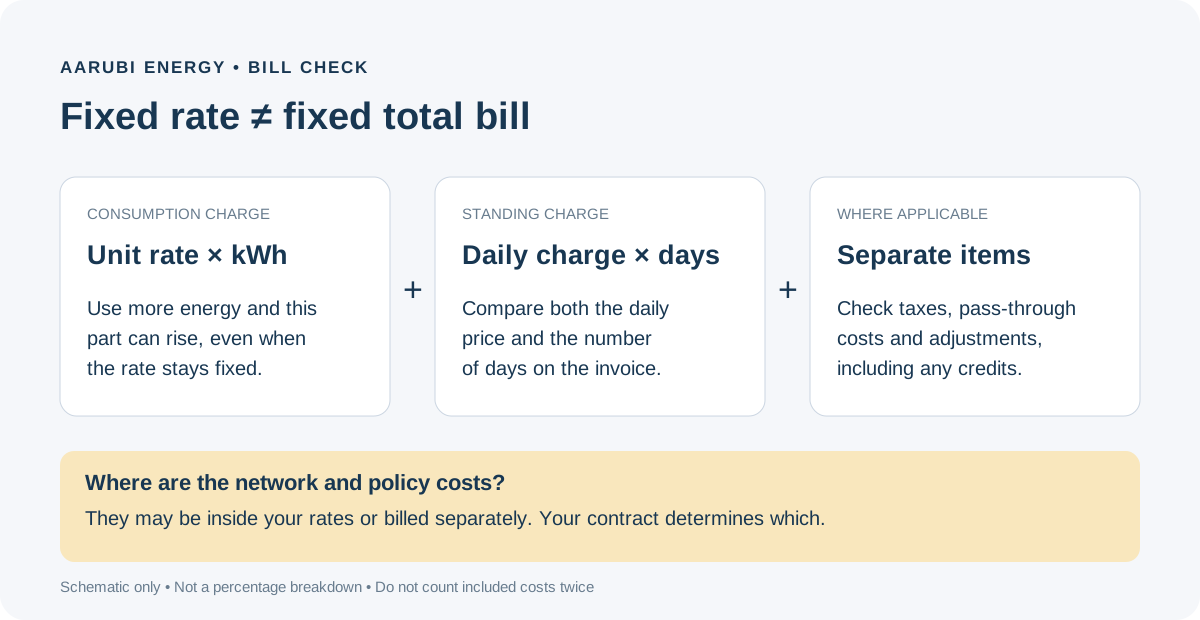
Before investigating a price increase, compare:
- kWh consumed and the number of days billed;
- actual versus estimated readings;
- unit rates and daily standing charges;
- separate levies, adjustments, credits and outstanding balances.
Then match each changed item to your contract.
Network delivery and infrastructure
TNUoS, DUoS and BSUoS explained simply: transmission moves electricity over the main grid, distribution brings it locally, and balancing keeps the system operating.
TNUoS: Transmission Network Use of System
TNUoS funds the high-voltage transmission network. Charges depend on the applicable tariff arrangements, including location and demand characteristics. A supplier may include these costs in its price or recover them separately. National Energy System Operator (NESO) TNUoS guide.
DUoS: Distribution Use of System
DUoS pays for the local networks delivering electricity to your premises. Your Distribution Network Operator (DNO) maintains that infrastructure. The relevant tariff can include consumption-related, fixed and capacity elements; it is not simply another wholesale energy price. EDF’s industry glossary.
AAHEDC: Assistance for Areas with High Electricity Distribution Costs
AAHEDC helps reduce distribution costs in the north of Scotland. The National Energy System Operator (NESO) recovers the assistance through charges on suppliers. Your premises do not have to be in Scotland for the underlying supplier cost to be relevant. NESO’s scheme explanation.
System balancing and capacity
BSUoS: Balancing Services Use of System
BSUoS covers the costs of balancing electricity supply and demand. Electricity has to be available when needed, not merely purchased in sufficient quantity over a month. These system costs are distinct from transporting electricity through cables. NESO’s BSUoS explanation.
CM: Capacity Market
The Capacity Market pays eligible capacity providers to be available when required. It supports security of supply and is not limited to conventional power stations: businesses reducing demand when needed can also participate through demand-side response. It is separate from the price of electricity actually generated. Government Capacity Market guidance.
Environmental and government policy levies
CfD: Contracts for Difference
CfDs support eligible low-carbon generation through an agreed strike price. Payments depend on the difference between that price and a reference market price; money can flow back when the reference price is higher. This is not simply a permanently fixed surcharge. Low Carbon Contracts Company (LCCC) CfD guide.
RO: Renewables Obligation
The RO is a legacy renewable-electricity support scheme. Suppliers meet obligations through Renewables Obligation Certificates, payments into a buy-out fund, or a combination. Costs can remain in supply prices even though the scheme is closed to new generating capacity. Ofgem’s RO overview.
FiT: Feed-in Tariffs
FiT supports eligible smaller renewable installations. Closure to new applicants did not end payments to existing accredited installations, so associated supplier costs continue. Ofgem’s FiT overview.
Nuclear RAB: Nuclear Regulated Asset Base
Nuclear RAB supports the financing of eligible nuclear developments, including costs before electricity generation begins. It is different from paying for nuclear electricity already delivered to your premises. LCCC’s Nuclear RAB overview.
EII Support Levy: Energy Intensive Industries
This levy funds network-charge compensation for eligible energy-intensive industries. Compensation for qualifying businesses and recovery of the scheme’s costs from suppliers are separate processes, with different timetables. Do not assume an ordinary SME receives this relief.
Taxes, metering and administration
CCL: Climate Change Levy
CCL is a tax on taxable business energy use, including electricity and gas. Exemptions and reductions exist, but eligibility depends on the supply and its use—not simply the business name. Government CCL guidance.
Elexon and DCC
Elexon administers electricity balancing and settlement arrangements. The Data Communications Company (DCC) operates the smart-meter communications network. Their functions and charging arrangements are different; do not treat “Elexon/DCC” as one universal fee. Elexon and DCC charges.
MOP, DC and DA
Meter Operator (MOP), Data Collector (DC) and Data Aggregator (DA) services cover metering equipment and consumption-data handling. Check whether your supplier includes them or you have separate agreements. Service terminology is evolving during market-wide half-hourly settlement migration. EDF glossary.
VAT: Value Added Tax
Business energy is generally standard-rated, with reduced-rate treatment for qualifying supplies. A fixed contract does not establish your VAT eligibility. Read our business energy VAT and CCL guide rather than assuming every small business qualifies. HMRC’s fuel and power guidance.
Ofgem fees and supplier administration
Ofgem receives industry licence-fee funding. That does not mean every business should expect a standard, separately payable “Ofgem fee”. Ask your supplier to explain any such line, its calculation and contractual basis. Ofgem funding information.
What is different on a business gas bill?
Gas has its own transportation and metering arrangements. Do not apply the electricity levy list wholesale to your gas invoice.
NTS: National Transmission System
NTS charges concern the high-pressure gas transmission network. These are transportation costs, distinct from buying the gas itself. National Gas charging information.
LDZ: Local Distribution Zone
LDZ charges relate to regional gas distribution. Network charges feed through the supply chain into customer pricing; the relevant network and charging structure matter. Cadent’s network-cost explanation.
Gas CCL
Gas can attract CCL, subject to applicable exemptions or reliefs. Check the gas-specific treatment rather than copying an electricity calculation. VAT also needs checking separately.
MAM and AMR
Meter Asset Manager (MAM) services concern the gas metering installation. Automatic Meter Reading (AMR) supports remote readings. Ask whether associated charges are included, separately billed or governed by another agreement. Gas metering terminology.
For quote-comparison advice, see our business gas rates guide.
What changed for 2026?
Three developments deserve attention, without assuming every customer receives the same increase:
- Nuclear RAB is part of the costs to check. LCCC’s first levy determination covered the obligation period from 1 October to 31 December 2025. That does not establish when an individual supplier first charged your business: check the invoice and contract. LCCC’s first determination.
- EII network compensation rose from 60% to 90% for eligible costs from April 2026. Payments are made in arrears; the corresponding Support Levy uplift takes effect from April 2027. These dates should not be conflated. Government confirmation.
- The 2026/27 TNUoS tariffs apply from April 2026. The effect depends on the site’s tariff and contract. An industry-wide headline percentage is not proof that your standing charge should rise by the same amount. NESO tariff information.
Which contract costs can change?
For a UK business choosing a fixed energy contract, this distinction matters more than the word “fixed” alone.
| Contract structure | Treatment of non-commodity costs | What to check |
|---|---|---|
| Fully fixed / inclusive | Specified costs are included at agreed prices; the supplier carries changes in those included costs. | Exclusions, taxes, new charges and change-in-law clauses. Usage can still change the bill. |
| Pass-through | Specified third-party costs are billed using the applicable actual charges. | Which costs vary, the calculation and supporting detail. The commodity price may still be fixed. |
| Fixed with reconciliation | Some costs are initially priced using assumptions and adjusted later under the agreement. | Reconciliation period, evidence, calculation and whether credits as well as debits apply. |
Supplier product names vary; they are not universal guarantees of what is included.
A fixed commodity rate can coexist with variable network charges. Equally, a supplier cannot justify every increase merely by saying “industry costs rose”. Ask for the specific clause and a calculation matching your site and billing period.
What can you do about a higher bill?
You cannot negotiate national policy away. You can check the invoice, reduce avoidable consumption and choose how much price risk your next contract leaves with you.
Request written confirmation of:
- which prices and charges are fixed;
- every permitted pass-through or reconciliation;
- how an adjustment is calculated;
- the total estimated cost using your actual consumption.
Review options before renewal, but do not assume switching mid-contract is possible without costs. Our contract-renewal guide covers the wider process.
Want a clearer explanation of your bill? Ask AArubi Energy for a free bill check and comparison. We can review your current charges and contract type, then compare suitable options for your renewal. Start with the AArubi Energy Bill Checker or contact AArubi.
Frequently asked questions
Can my business electricity bill go up on a fixed contract?
Yes. Consumption, billing-period length and corrected readings can change the total. Specified pass-through charges or reconciliations may also change it where your contract permits them.
What is the difference between fixed and pass-through contracts?
A fixed product fixes the prices it expressly includes. A pass-through product leaves specified third-party costs variable, even if its wholesale-energy component is fixed.
Can my business electricity standing charge increase mid-contract?
Check whether that charge is fixed and whether relevant exceptions apply. Ask the supplier for the contractual basis, effective date and calculation before accepting an unexplained increase.
Does a lower wholesale price mean my next bill will fall?
Not necessarily. Your agreed commodity price may remain fixed, while consumption and non-commodity costs also affect the amount payable.