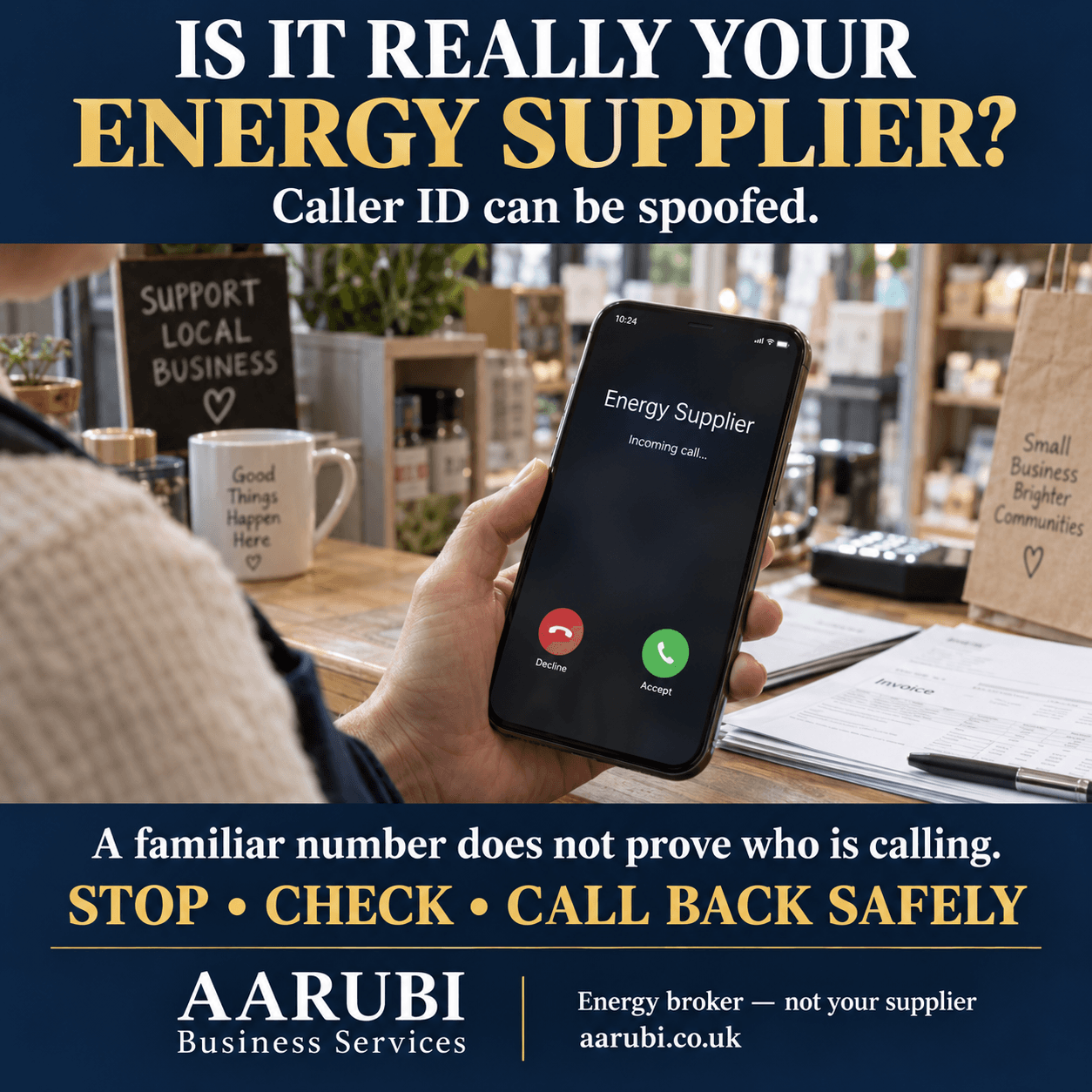
The phone rings while you are serving a customer. The caller says they are from your current electricity supplier and need to sort out your renewal. They sound confident. They know your business name. The number on your screen even looks familiar.
None of those details, on their own, proves who is calling.
This guide explains how to handle business energy scam calls, misleading broker approaches and number spoofing without ignoring genuine account issues. The energy-contract guidance below covers Great Britain; Northern Ireland has separate energy regulation. Sources checked on 15 October 2026.
Quick answer
- Treat an unexpected energy call as unverified, even if the displayed number matches your supplier.
- End a doubtful call and contact your supplier through independently checked details.
- Keep decisions about contracts and payments with a named person in your business.
- Always ask for the offer and full terms by email for review before agreeing. Do not accept verbally just to receive the paperwork.
- A broker should explain their role. Being a broker is not the problem; pretending to be someone else is.
Supplier, broker or impersonator: what is the difference?
Your supplier provides your energy under the supply contract. A broker helps arrange a contract, potentially with one of several suppliers. A supplier may also use an authorised third-party sales agency, so an external caller is not automatically fraudulent.
The important question is whether the caller accurately explains their identity, employer and role. “We deal with your supplier” is not the same as “we are your supplier”.
Ofgem's guidance for intermediaries expects clear explanations of who they act for, which suppliers they compare and how their commission or fees work. It is guidance on expected standards, not a reason to assume every caller has been individually approved by Ofgem.
Ask: “What is your company's full name, are you a supplier or intermediary, and which organisation has authorised this call?” Then verify the answer independently.
What is number spoofing?
Number spoofing means faking the number shown by caller ID. A call can appear to come from a familiar organisation even though it did not originate there. A matching phone number is therefore not an identity check.
Ofcom warns about this in its scam-call protection guidance. Knowing your details is also not proof of authenticity.
Do not use the displayed number as evidence against the business that genuinely owns it. That organisation may itself be the victim of impersonation.
What genuine suppliers will and will not do
There is no single contact policy shared by every supplier. The following examples come from suppliers' own published guidance, checked on 15 October 2026. British Gas Business and EDF Small Business have business-specific guidance; E.ON Next's linked page is general customer guidance. Check your own supplier's current business contact arrangements rather than treating this as a universal rulebook.
What a genuine supplier may legitimately do
A genuine supplier may contact you about your account, request meter readings, discuss an outstanding balance or arrange a meter appointment. EDF's published calling-number list includes business sales, small-business support, revenue collection and meter services. It also identifies a meter-installation partner. An unexpected call or a different company name therefore needs verification, not an automatic accusation.
EDF's fraud guidance says its callers identify themselves and ask security questions before discussing the account. You do not have to answer an unverified incoming caller: end the call and complete any necessary checks through a trusted supplier contact route instead.
Supplier-specific promises and safeguards
| Supplier and official guidance | What it says it will or will not do | What this means for your business |
|---|---|---|
| British Gas Business: online security | Account communications use your name and account number. It says it will not request passwords, personal information or account updates by email. | Treat an email asking you to send those details as suspicious. A correct name or account number is a clue, not proof of identity. |
| British Gas Business: energy fraud | It says a genuine company will allow time to consider a contract, and advises checking payment details directly through a trusted number. | Do not let pressure replace independent verification or a proper review of the terms. |
| EDF Small Business: fraud awareness | It says it will not pressure you to act immediately or request bank details out of the blue. Its customer-service team can help verify unexpected contact. | An urgent, unexpected request for banking information is a reason to stop and contact EDF independently. |
| E.ON Next: staying safe online | Its specialists will accept a callback if you are uncomfortable. It says it will not ask you to share bank details or passwords in an email. | End an uncomfortable call and use the business contact details on your bill or its official website. Do not email those sensitive details. |
Keep the channel distinction: “we will not ask by email” does not mean a supplier never needs payment information in a legitimate, independently verified payment process. Equally, a caller asking security questions is not proof that they work for the supplier.
Published calling numbers and recognisable email addresses are useful cross-checks, but they are not authentication. Caller ID can be spoofed, and a familiar sender name or logo can be copied. Open your supplier's website or account portal independently when checking a message.
Avoid blanket claims that suppliers never call, never use agents or never discuss debt. Verify the contact first, then deal with any genuine account issue promptly.
Warning signs in an unexpected energy call
These are reasons to pause and investigate, not proof that a particular company is committing fraud.
| What the caller says or does | What to check before acting |
|---|---|
| “Your renewal must be agreed today.” | Check the end date and notice requirements in your own contract records. |
| “We are your existing supplier.” | Ask for the legal company name and verify the claimed relationship through your supplier. |
| “We just need a bill to update your account.” | Establish who wants it, why they need it and where it will be sent. |
| “Confirm these details; it is only administration.” | Ask whether you are authorising a quotation, a contract, a switch or a payment. |
| “Pay now or you will be disconnected.” | Contact the supplier's established accounts team independently to check the claimed debt. |
| They refuse written terms or a clear explanation of their role. | Stop the conversation until those points can be checked. |
For a shop or takeaway handling calls during busy service, keep the process simple: staff note the claimed company name and pass the enquiry to the authorised contact. That person checks the existing agreement and contacts the supplier independently before discussing a renewal.
How to check a supplier call safely
Hang up if you are uncertain. Find contact details on a bill you already trust or by opening the supplier's official website independently. Do not use a link or callback number supplied during the suspicious conversation. Where possible, make the verification call from another phone.
Ask the verified supplier whether the call was theirs, whether the named agency works for them and whether your account needs action. Avoid sharing passwords, security codes or bank details with an unexpected caller.
Ofcom recommends independent contact rather than relying on the incoming call. Phone screening can help, but it is not a substitute for verification.
A short script for staff
We do not agree energy contracts or payment changes on incoming calls. Please give me your company's full legal name and email the quotation and full terms for review only. I am not accepting an offer, appointing a broker or authorising a switch or renewal. Our authorised contact will verify the details independently.
The script removes pressure from someone who is busy, new to the business or unfamiliar with energy contracts. It also gives a genuine caller a clear route to the right person.
Can a phone conversation create a binding energy contract?
Yes: do not assume that an unsigned contract is an unagreed contract. Citizens Advice's business switching guidance explains that agreement by phone can bind a business without a signature. It also warns that agreeing to use a broker by telephone can be binding. A brokerage service agreement and the supplier's energy contract are not necessarily the same agreement.
In practical terms, the risk arises when a conversation moves from discussing a quotation to accepting an offer or giving someone authority to act. The particular terms, words used, circumstances and authority of the person speaking matter. A recording can be evidence of what was agreed; recording the call is not, by itself, what creates a contract.
There is no magic word that automatically creates every contract, and saying “yes” to a factual question is not automatically acceptance of an energy deal. Equally, do not assume that only the director can bind the business or that your internal approval policy guarantees protection. An individual dispute needs advice on its actual facts.
What not to say if you only want a quotation
Our suggested wording below is a precaution, not a guarantee about how a court or dispute scheme would interpret a call.
| Avoid saying when you have not decided | Say clearly instead |
|---|---|
| “Yes, go ahead” or “I accept those rates.” | “Please email the quotation for review. I am not accepting it.” |
| “Lock that price in for us.” | “How long is the quotation valid? Do not book or submit a contract.” |
| “Renew it” or “Switch us over.” | “We are comparing options only. No renewal or switch is authorised.” |
| “You can sign or sort everything for me.” | “Do not sign or accept anything on our behalf. Send any proposed authority document for review.” |
| “Yes” to a series of agreement questions just to end the call. | “I am stopping this call. Please email the documents; I am not agreeing to a contract.” |
If a caller asks you to repeat acceptance wording, complete a recorded agreement or confirm you are authorised to accept, stop unless you genuinely intend to commit and have checked the offer. Do not claim authority you do not have.
Always ask them to email before you agree
Make written information first, a considered decision later your business rule. Ask for:
- the caller's employer, legal business name, trading name and role;
- the quotation, principal terms and full supplier terms, including all prices, dates, fees and exit conditions;
- any separate broker-service terms, commission disclosure and letter of authority;
- the quotation's expiry time and a clear explanation of what any link, tick box or signature will authorise.
An email request is not a cancellation method: it does not undo acceptance already given. Avoid “yes, go ahead and email it”. Ask for documents for review only, and remain consistent in the rest of the conversation and subsequent messages. An acceptance by email or electronic signature can also have contractual consequences.
An email is a record, not proof of identity. Verify the sender and any signing link independently. Do not share a security code or click an acceptance button merely because someone calls it “verification” or “just to see the price”. If you cannot view the terms without accepting them, request a readable copy first.
How to identify the broker behind a supplier-branded contract
A genuine supplier portal does not prove you dealt directly with the supplier. EDF's small-business broker guidance describes portal access for brokers and sub-brokers, including arrangements where one intermediary quotes and submits contracts for another. Supplier branding and broker involvement can therefore legitimately coexist.
Distinguish two questions: is the document or portal genuine, and who arranged the sale? Establish both before accepting. A supplier contract may name the supplier as the contracting party while a broker arranged it and receives commission.
Where to look in the paperwork
Download the proposed documents before signing and look for the following clues. Labels vary; not every document contains every field.
- Broker, intermediary, TPI, introducer, partner or agent: TPI means third-party intermediary. Check the legal name as well as the trading name.
- Commission or remuneration disclosure: identify who receives payment, how it is calculated and whether it is included in the energy price or charged separately.
- Sales or agent reference: ask the supplier to explain an unfamiliar code rather than guessing which business it identifies.
- Letter of authority and broker-service terms: check whose name appears and what permission or separate fees they create.
- Signing invitation and audit trail: inspect the sender, document reference and any available signing history. These are clues to verify, not conclusive proof of the sales channel.
If the broker is not identifiable, do not assume there is none. Contact the supplier independently and ask:
Is this quotation or contract direct, or was it introduced by a broker? Please confirm the legal name of the intermediary recorded against it, any known sub-broker, the commission or fees attached, and whether it is a proposal or has already been submitted as accepted. Please email your answer.
Ask the caller to explain any difference between their company name and the supplier's recorded intermediary. There may be an aggregator or sub-broker arrangement, but you should understand it before proceeding. Do not assume that an unclear name proves fraud.
EDF also offers a broker commission information request for business customers whose EDF contract was arranged through a broker. Other suppliers have their own enquiry routes. This is useful corroboration; it does not replace checking the complete contract and any separate broker agreement.
Put a simple approval process in place
Our practical recommendation is to keep a small energy-contract record for each site. Include the supplier, account reference, contract end date, notice requirements and the person authorised to approve changes. Keep it secure rather than pinned up where customers can see it.
For businesses with several premises, ask site managers to route renewal calls to the same central contact. Otherwise, different locations may receive conflicting instructions without anyone seeing the whole picture.
- Brief reception, shop-floor and finance staff on the call-handling script.
- Require a second internal check for changes to payment details.
- Keep quotations and approvals together so a colleague can understand what was agreed.
- Check unfamiliar documents before signing, including letters of authority.
A letter of authority should be read for its actual scope: do not assume that every version gives the same permissions. Ask the broker to explain any wording you do not understand before you sign.
Check the contract, not just the sales pitch
Once you have verified the business you are dealing with, assess the offer separately. A genuine caller can still offer a contract that does not suit your needs.
For the wider due-diligence checklist, see Business Energy Broker Red Flags: 12 Checks Before You Sign. This article focuses on establishing who is calling and responding safely when their identity is uncertain.
Request the supplier name, start date, duration, unit rates, standing charges, renewal arrangements, exit provisions and broker remuneration in writing. Compare like-for-like usage and contract periods rather than a headline monthly estimate.
Do microbusinesses have a 14-day cooling-off period?
Do not assume so. As checked on 15 October 2026, Ofgem's current business-contract guidance states that there is no cooling-off period after agreement. Ofgem consulted on a microbusiness cooling-off right but decided not to implement that proposal in its March 2022 review. A consultation proposal is not an enacted right. Check any cancellation concession expressly offered in your own contract; do not assume you can change your mind without cost.
Check the broker's dispute-resolution scheme
Ask for the broker's legal name, scheme name and membership reference, then verify membership with the scheme itself. Ofgem's supplier rules require suppliers securing microbusiness and small-business contracts through intermediaries to work with brokers belonging to a qualifying redress scheme. The rules also extend broker-fee transparency in principal terms to all non-domestic customers. Ask for the commission or fee basis in writing before agreeing. Scheme membership provides a complaints route; it does not authenticate an incoming caller or guarantee that an offer is suitable.
Our business energy FAQ explains common contract questions. If a caller uses a higher bill as a reason to rush you into switching, first read why a business electricity bill can rise on a fixed contract. A higher bill does not, by itself, establish that you need a replacement contract.
What if you have already shared details or agreed something?
Act promptly, but avoid making another rushed decision to undo the first one.
If money or banking information is involved: contact your bank through a trusted channel immediately and explain what happened. Follow its advice on protecting the account.
You can also hang up and dial 159 to connect to a participating bank through Stop Scams UK's service. Check its bank and phone-provider coverage; call charges vary. If your bank is not available, use the trusted number on your bank card or in its app. This is a banking contact route, not an energy-supplier helpline or a substitute for reporting fraud.
If a contract or switch is disputed: contact the relevant supplier and broker in writing. Explain exactly what you believed you were agreeing to and what you now dispute. Request the contract documents, any relevant call recording, authority records and their complaints procedure. Do not assume the agreement is automatically void or that stopping payments resolves it; seek advice on your circumstances.
Preserve evidence: keep the time of the call, the displayed number, claimed company name, emails and documents. Record what was said while it is fresh. Describe the number as the one displayed, not as a verified source of the call.
Ofgem's complaints guide explains escalation. Ofgem does not resolve individual disputes. Eligible unresolved complaints may go to the Energy Ombudsman after eight weeks or a deadlock response; check business eligibility and whether the relevant supplier or broker is covered.
For suspected fraud in England, Wales or Northern Ireland, use Report Fraud or call 0300 123 2040. Report Fraud replaced Action Fraud on 4 December 2025, retaining the phone number. In Scotland, report to Police Scotland on 101, as directed by Ofcom's reporting guidance. Keep fraud reporting separate from a contractual complaint; you may need both.
How Aarubi can help
Aarubi Business Services is an energy broker, not your energy supplier. We can help you understand an offer, review your renewal information and compare business energy options. We cannot authenticate a caller merely from the displayed number or guarantee that a disputed contract can be cancelled.
Use our energy bill checker to explore your bill, or contact Aarubi to discuss your options. A bill-checking tool is not a fraud investigation or an identity-verification service. Never put bills, account details or bank information in public comments.
Call 07989 225 885 or email info@aarubi.co.uk.
Frequently asked questions
Can scammers use my energy supplier's actual phone number?
They can make caller ID display a number belonging to someone else. That does not establish that they control the supplier's phone system. Verify an unexpected call through a separate, trusted contact route.
Are all business energy brokers scams?
No. Brokers can help businesses arrange energy contracts. Assess their identity, service, supplier coverage, charges and terms. Misrepresenting their identity is different from openly providing a brokerage service.
Should I send my energy bill to someone who calls me?
Not before verifying them and understanding the purpose. Bills can be useful for legitimate comparisons, but an unexpected request is not enough reason to send one. Agree a secure sharing method with the verified organisation.
Does reporting a suspicious call cancel an energy contract?
No. Reporting and cancellation are separate matters. If an agreement is disputed, contact the parties promptly, retain evidence and use the appropriate complaints process. Get independent advice where the position is unclear.
Is Ofgem calling me to request bank details?
Do not provide them. Ofgem's fraud warning says it never asks for bank or personal details. End the call and verify any claimed regulatory contact independently through Ofgem's official website.
Can a broker say they are from British Gas or EDF?
A broker or authorised agent must accurately explain their identity and role. Working with a supplier does not make them the supplier. Ask for the caller's legal company name and confirm the relationship with the supplier independently, even if the documents arrive through a supplier-branded portal.
How do I report a business energy scam call?
For suspected fraud, use Report Fraud online or 0300 123 2040 in England, Wales or Northern Ireland, or Police Scotland on 101 in Scotland. Contact your bank immediately if money or banking information is at risk. Raise any disputed energy agreement separately with the supplier and broker.
This article provides general awareness information, not advice on the legal outcome of an individual dispute. For details of how our content is prepared, see our editorial policy.