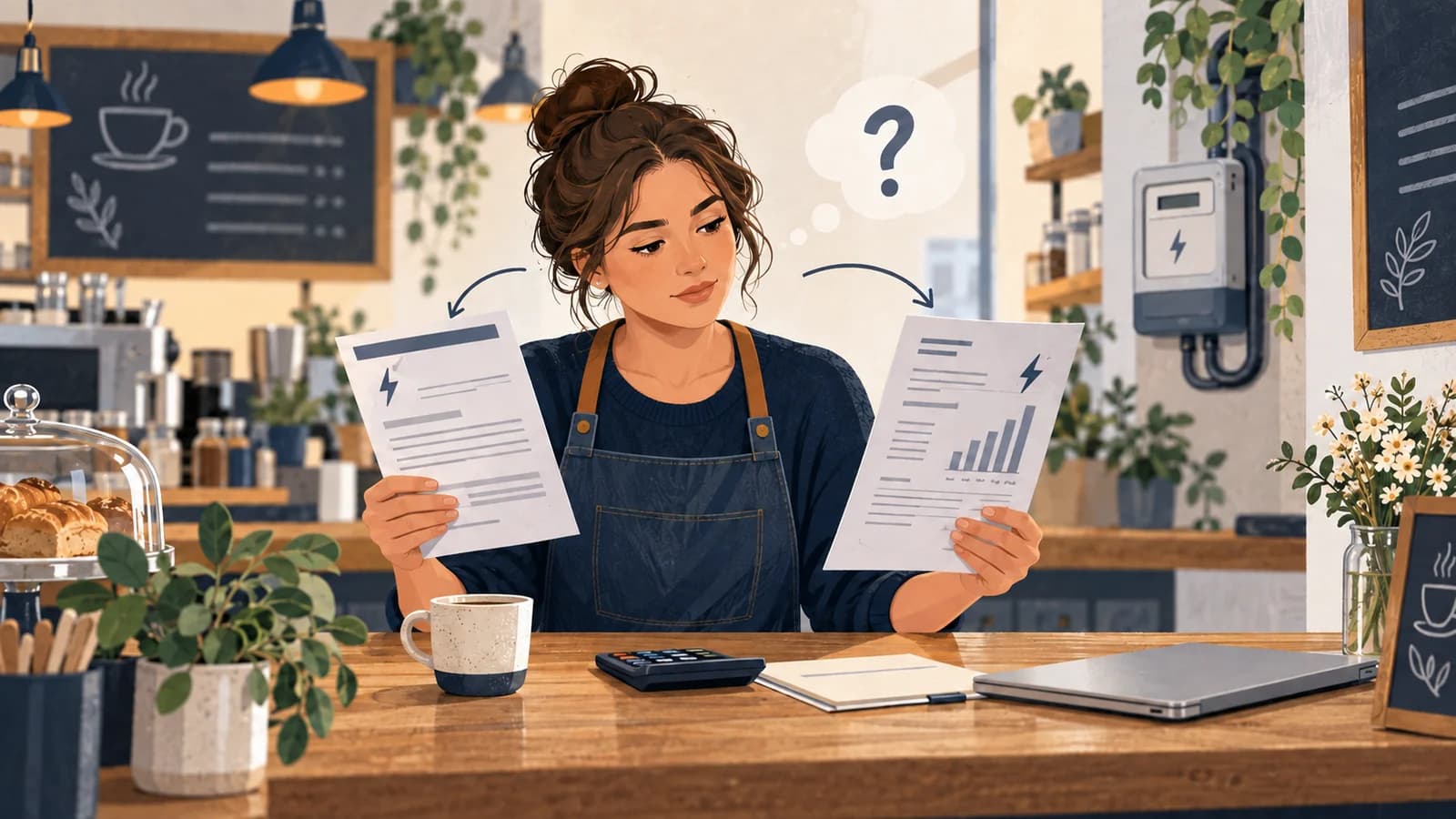
Receiving an incorrect business energy bill is more common than most SME owners expect. Whether it stems from an estimated read that drifted for months, a unit rate that does not match your signed contract, or VAT charged at the wrong percentage, the financial impact can be significant — and the error is rarely corrected automatically. This guide walks you through every step of identifying, evidencing, and formally disputing a billing error with your supplier, and explains what to do if the process stalls.
Why Business Energy Bills Go Wrong
Business energy billing involves several moving parts — meter data, contract terms, network charges, levy calculations, and VAT rules — and errors can creep in at any stage.
The most frequent causes include:
- Estimated meter reads that have not been corrected by an actual read for several billing periods, leading to a large catch-up bill or a significant credit balance.
- Unit rate or standing charge discrepancies where the rate applied differs from what is stated in your contract or tariff schedule.
- VAT rate errors, particularly for businesses that qualify for the reduced 5% rate but are being charged 20%.
- Climate Change Levy (CCL) charges applied incorrectly, for example to supplies that qualify for an exemption.
- Wrong meter point reference number (MPAN for electricity, MPRN for gas), meaning your account is being billed for a different site or a meter that is not yours.
- Duplicate invoices or invoices issued after a contract ended.
Understanding which category applies to your situation shapes the evidence you need and the argument you make.
---
Check Your Bill Against Your Contract First
Before contacting your supplier, do the forensic work yourself. Disputing an incorrect business energy bill without a clear position weakens your case and slows resolution.
What to compare line by line
Pull out your energy contract or the welcome letter that confirmed your tariff when you signed up. Then lay it alongside the disputed invoice and check:
- Unit rate (p/kWh) — does the rate on the bill match the rate in your contract, including any seasonal or time-of-use variations?
- Standing charge (p/day) — is this consistent with your agreement?
- Meter read dates and values — are the opening and closing reads on this invoice plausible given your consumption history?
- VAT rate — businesses using energy primarily for non-domestic purposes pay 20% VAT; those qualifying as low-consumption or using energy for specific eligible purposes may pay 5%. Check HMRC's guidance on VAT for fuel and power for the eligibility criteria.
- CCL — if you hold a levy exemption certificate (e.g., for renewable electricity), this should not appear on your bill.
Note every discrepancy and calculate the approximate financial impact for each one. This becomes your dispute schedule.
Obtain your consumption history
Most suppliers provide a consumption history via their online portal or on request. Download or request at least 24 months of reads and usage data. Gaps, unexplained spikes, or long runs of identical estimated figures are clear signals of a metering problem.
---
Four Common Billing Errors and How to Identify Each
| Error type | How to spot it | Key document needed |
|---|---|---|
| Estimated reads / catch-up bill | Bill shows "E" next to meter reads; large balance correction appears suddenly | Actual meter read photo with date/time stamp |
| Wrong unit rate | Rate on invoice differs from contract schedule | Signed contract or tariff confirmation letter |
| VAT at 20% instead of 5% | VAT line shows 20%; your usage or business type qualifies for reduced rate | HMRC eligibility evidence; signed VAT declaration to supplier |
| Wrong MPAN or MPRN | Site address on bill does not match your premises; bill references an unfamiliar meter serial number | Meter serial number (found on the meter itself); lease/title documents |
Work through this table systematically. If more than one error applies, list them separately in your correspondence — bundling multiple issues in vague terms makes disputes harder to track.
---
How to Submit a Formal Dispute to Your Supplier
Once you have your evidence, raise the dispute in writing. A phone call alone is insufficient; it creates no audit trail and is too easy for suppliers to lose in their records.
Step 1 — Submit a written complaint
Email your supplier's dedicated business complaints address (usually listed on the back of your bill or their website). Include:
- Your account number and site address
- The invoice number(s) you are disputing
- A clear, itemised list of each error with your calculation of the correct figure
- Copies of supporting documents (contract, meter read photo, VAT declaration, etc.)
- A specific request: a corrected invoice, a refund, or a credit note — whichever applies
Keep your language factual and professional. State that you expect a response within the timeframes required by Ofgem's complaint-handling rules.
Step 2 — Escalate within the supplier if needed
Under Ofgem's complaint-handling standards, suppliers must acknowledge complaints promptly and provide a substantive response. If your initial contact does not resolve the matter, ask for the complaint to be escalated to the supplier's formal complaints team and request a unique complaint reference number.
Step 3 — Request a deadlock letter or wait eight weeks
If the supplier either rejects your complaint or fails to resolve it within eight weeks, you are entitled to refer the matter to the Energy Ombudsman. You can also request a deadlock letter sooner if the supplier confirms they cannot resolve it. Do not let more than eight weeks pass without chasing — the eight-week clock gives you the right to escalate.
---
Looking to reduce your business operating expenses? Aarubi can review your energy, card processing, insurance and business funding options. Request a free consultation
---
Escalating to the Energy Ombudsman
The Energy Ombudsman is a free, independent service for business energy customers. It handles disputes between energy consumers and licensed suppliers, and its decisions are binding on the supplier (though the customer can choose to reject the outcome and pursue other routes).
Who can use it
The Energy Ombudsman service covers micro-businesses — broadly defined as organisations with fewer than 10 employees and an annual turnover or balance sheet total not exceeding €2 million. If your business falls outside this definition, you may need to consider alternative dispute resolution or legal routes, though many suppliers voluntarily apply similar processes for larger SMEs.
What to submit
When you refer to the Ombudsman, provide:
- Your complaint reference number from the supplier
- A chronological summary of events
- Copies of all correspondence
- Your evidence file (contract, reads, invoices, calculations)
- The outcome you are seeking
The Ombudsman will investigate and may direct the supplier to correct the bill, issue a refund, pay compensation, or provide a written apology. Resolution typically takes several weeks, depending on complexity.
---
Back-Billing Rules: How Far Back Can a Supplier Charge You?
Back-billing — where a supplier issues a corrected bill covering a long period of under-charging — is a legitimate concern for SMEs who have received estimated reads for months or years.
Under industry arrangements, suppliers generally cannot recover charges for energy consumed more than 12 months before the error was identified for micro-businesses. This protection is not a statutory right in the same way as some consumer protections, but it is embedded in supplier licence conditions and Ofgem's back-billing guidance.
If you receive a large backdated bill, challenge it immediately. Ask the supplier to confirm in writing the date they identify as the point the error was first discoverable, and compare that against the 12-month window. If the charge extends beyond it, cite Ofgem's position explicitly in your written dispute.
Note that back-billing rules work both ways: if your supplier has been overcharging you, you are entitled to seek refunds or credits for the full period of the overcharge, not just 12 months.
---
What to Do If Your Meter Data Is Wrong
Meter read disputes are often the most complex to resolve because they involve third-party data (meter operators and data collectors) as well as the supplier.
If you believe the meter itself is recording incorrectly, you can request a meter accuracy test. The supplier arranges this; if the meter is found to be faulty, the cost of the test is typically met by the supplier or network operator. If the meter is accurate and the reads were estimated, you simply need to provide actual reads and negotiate a re-bill based on them.
To protect yourself going forward:
- Submit regular meter reads through your supplier's portal, ideally monthly
- Photograph your meter on the same day each time, with a visible date stamp where possible
- Keep a simple spreadsheet of reads so that any anomalous bill is immediately visible
For sites with smart meters, check whether your data is actually being transmitted. Smart meters sometimes enter "dumb" mode after a supplier switch, reverting to estimated billing. If this has happened, ask your new supplier to recommission the smart meter's data connection.
---
Action Checklist
- [ ] Obtain your original signed contract or tariff confirmation letter and compare rates line by line against the disputed invoice.
- [ ] Photograph your current meter read with a date and time stamp and note the meter serial number.
- [ ] Download or request 24 months of consumption history from your supplier's portal or by written request.
- [ ] Calculate the financial impact of each error separately and create a brief dispute schedule.
- [ ] Send a formal written complaint to the supplier's business complaints address, listing each error with supporting evidence attached.
- [ ] Note the date you submitted and diarise the eight-week escalation deadline.
- [ ] If VAT was charged at 20% and you qualify for 5%, submit a VAT declaration form to your supplier and request backdated adjustment.
- [ ] If the supplier has back-billed beyond 12 months, cite Ofgem's back-billing position in writing and ask for confirmation of the date the error was first identifiable.
- [ ] If unresolved within eight weeks (or a deadlock letter is issued), refer to the Energy Ombudsman with your full evidence file.
---
Review Your Tariff While the Account Is Open
A billing dispute opens a conversation with your supplier that is worth making the most of. Once the error is corrected, you will have a clear picture of your actual consumption and the rate you are paying. That makes it a practical moment to assess whether your current contract remains competitive.
Our business energy comparison service can help you benchmark your current rates against the market without commitment. You can also use the Aarubi energy bill checker to flag anomalies before they develop into a formal dispute.
If reducing your overall operating costs is a priority — not just energy but also card processing fees and insurance premiums — a joined-up review often uncovers more than any single audit. Compare tariffs and providers or speak to the Aarubi team to explore what is possible for your business.
---